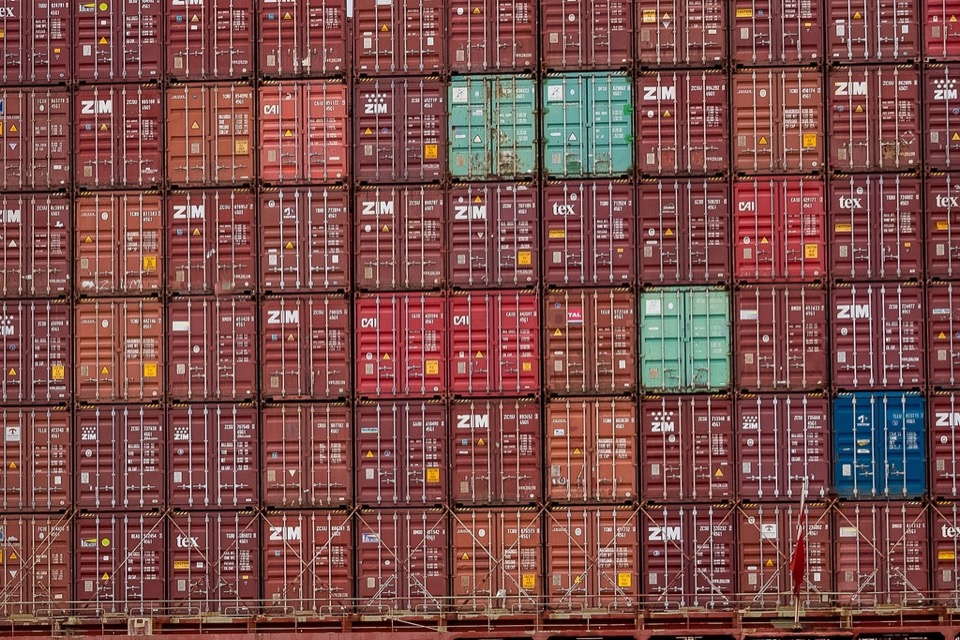
Logistics has an advantage over every other sector in this market, and most operators here are not using it.
The advantage is that the results are physical. A container is either in the right stack or it is not. A truck either waits 40 minutes or it waits 20. A shipment either clears or it sits. Nobody has to argue about whether the model helped.
MIT's NANDA study found that 95% of generative AI pilots produced no measurable profit and loss impact, and attributed the failure to tools that sit outside the workflow where the money is. In logistics the workflow where the money is has a gate, a yard and a clock attached to it. That is why this sector produces evidence faster than the sectors with better software.
What the large operators have already proved
DP World has deployed an AI-powered yard management system at the Jebel Ali Terminal in Dubai. It uses machine learning to optimise container placement and movement, with the stated aims of reducing truck turnaround times, reducing human error and improving throughput capacity.
BOXBAY, the high-bay storage system developed and proven at Jebel Ali, is stated to triple terminal capacity while cutting energy costs by 29%.
Those are the operator's own figures and they should be read as such. What they establish is not a benchmark for your business. They establish that the physical AI use cases in this market are past the demonstration stage, which is the fact a board needs before it approves anything.
Where a mid-market operator should actually start
Not autonomy. Not a control tower. Not a digital twin.
Exception handling. In most freight forwarders a small share of shipments consumes most of the operations team. Customs holds, missing documents, short-shipped consignments, demurrage risk. Nobody can say in advance which shipments those will be, so the team treats all of them the same and the margin goes into manual work.
A model that flags the shipments likely to need intervention changes how the day is organised without changing anything physical. It uses data the company already has, it produces a number the finance team already reports as detention and demurrage cost, and it fails visibly if it is wrong.
Demand and inventory forecasting. For distributors, this is the same argument applied to stock rather than to shipments.
Document extraction. Bills of lading, commercial invoices, certificates of origin, delivery notes. High volume, structured enough to be tractable, and measured in hours of clerical time.
Those three cover most of the value available to a mid-sized UAE operator, and none of them requires a change to the yard.
The governance question, sized correctly
Logistics AI splits into two categories and the split decides how much governance each side needs.
Systems that touch cargo, containers, routes and equipment do not process personal data. They carry commercial risk and safety risk. They do not carry the Personal Data Protection Law obligations, and putting them through a full impact assessment wastes the time of the people who should be assessing the other category.
Systems that touch people do. Driver behaviour monitoring, in-cab cameras, workforce scheduling, warehouse productivity tracking, and CV screening in recruitment. Every one of those processes personal data, several produce decisions that seriously affect a person's employment, and the PDPL gives that person the right to object to a decision made by automated processing.
Draw the line on the register on day one. It is the single most useful hour an AI owner spends in this sector.
The data problem specific to freight
Every logistics AI vendor demonstrates on clean data. No UAE forwarder has clean data.
The shipment record lives in the transport management system, the customs record lives with the broker, the cost sits in the finance system, and the truth about what happened is in a WhatsApp thread between the operations coordinator and the driver.
This is not a reason to postpone. It is a reason to choose a first use case whose data lives in one system. Exception handling usually does. Route optimisation across a mixed fleet usually does not, which is why route optimisation projects here take a year and produce a report.
What the seat holds in logistics
The register, split into the two categories above. Assessments on the people-facing half. A vendor position, because in this sector most AI arrives inside a transport management system, a telematics platform or a customer's portal rather than as a purchase of its own. The staff policy, written for operations coordinators and drivers rather than for head office. And one use case with a number: detention and demurrage, cost per shipment touched, or clerical hours per consignment.
In a forwarder or third-party logistics operator of a few hundred people that is two or three days a week, held by someone who has taken a model into a live operation before and knows what happens when the yard disagrees with the screen.
Nothing on this page is legal advice.
Where to go next
For every UAE rule in one place, read the map of UAE AI regulation. For the order of work, read AI transformation in the UAE.
If you have run AI inside a Gulf logistics operation, claim a page. If the first use case needs an owner, read the register.